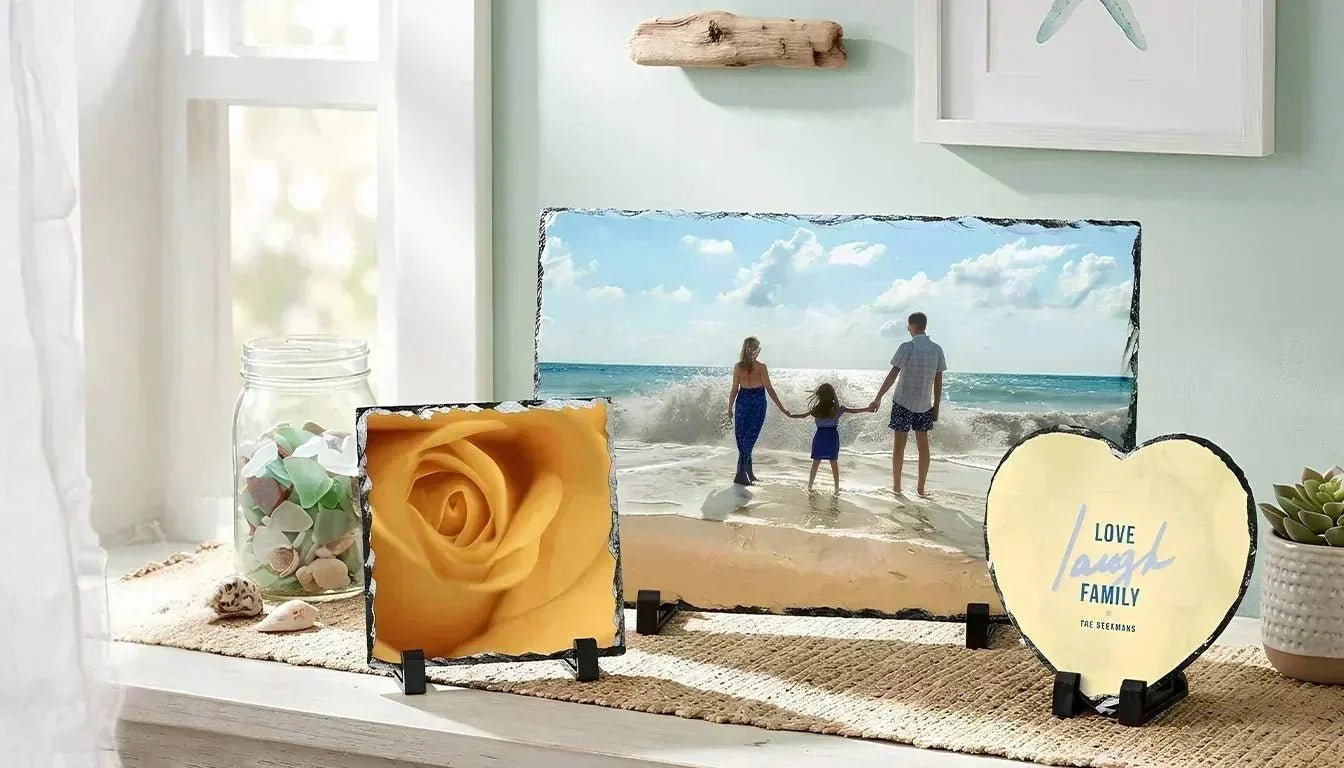
Photo slates are one of the most distinctive products within the sublimation assortment. It combines modern printing technology with a natural material, resulting in a unique finished product with a premium appearance.
Because of its natural structure, every slate is different. This gives each item an exclusive character that fits perfectly within personalized gift concepts. Its robust finish and availability in different shapes, sizes, and finishes make it a versatile product for a wide range of applications within your assortment.
The Slate
Photo slates stands out because it combines the look of natural stone with the possibilities of sublimation. This makes it an attractive product for businesses looking to offer something different from standard blanks.
The natural edges and unique texture give every finished item its own appearance. That makes photo slates especially suitable for premium gifts, memorial products, and decorative items with added emotional value.

Printing Technique
Photo slates requires a different approach than most standard sublimation products. The same applies to tiles. To print it, use a flat heat press.
The recommended settings, based on an Sefa setup, are:
Temperature: 190°C
Time: 360 seconds
Pressure: medium
The most important difference is the positioning during pressing. Slate is printed indirectly. This means you first place the transfer paper with the image facing upward on the press. Then place the slate with the printable side facing downward on top of the paper.
During pressing, the heat passes through the stone. This results in a longer pressing time, but also in a deeper and higher-quality print inside the material.

Tips & Tricks
Preheating for better results
Preheating the slate briefly without a transfer helps create a more stable temperature inside the material. This contributes to stronger colors and a more consistent final result.
Control over the finish
The characteristic edges and cracks of photo slate create additional possibilities in the final appearance. Do you want to keep the edges more white? Use the standard method described above.
Do you want the image to continue into the edges? Use a soft base such as a foam pad. This allows the slate to press slightly into the pad, so the transfer paper wraps more around the edges. The result is a more full-coverage effect.
This technique can also be applied to standard tiles with rounded edges.
Budget Alternative
Looking for a low-threshold solution without additional investment? A folded bath towel can be used as an alternative to a foam pad.
By using a double-folded towel underneath the transfer and the slate, you create a softer base during pressing. This gives a similar effect to a foam pad, allowing the transfer paper to form slightly around the edges of the slate. As a result, the image can extend further into the cracks and edges, creating a richer overall finish.
Keep in mind that the result may be slightly less consistent than when using a professional foam pad. For test production, smaller runs, or occasional use, however, it is a practical and cost-effective option.
Important: always use an old towel. Ink residue from the sublimation process may remain visible in the fabric after use.